
Last Updated: October 30, 2026
Quick Summary
Hiring offshore Revit drafters in 2026 is worth it for mid-sized US architecture firms because it absorbs construction documentation and redline work without adding permanent overhead. Offshore managed placements can cost substantially less than fully loaded domestic hires, since payroll, benefits, recruiting, and seat costs are removed rather than hidden in a lower salary.
- Compare offshore rates against fully loaded domestic cost, not salary alone.
- Week one of onboarding should cover standards and templates, not production.
- Set a daily two-to-three-hour overlap window and rely on written handoffs otherwise.
- Insist on signed confidentiality and IP assignment agreements plus role-based file access.
- No long-term contracts let you add or reduce drafters as projects ramp and close.
Table of Contents
- Why US Architecture Firms Are Hiring Offshore Revit Drafters in 2026
- Offshore vs. Onshore: A Cost-Benefit Breakdown
- Revit Drafter Interview Questions That Reveal Real Skill
- Building a Revit Drafting Test for Candidates
- Vetting Offshore Talent: Portfolios, References, and Red Flags
- Remote Architecture Staff Onboarding: The First 30 Days
- Offshore Drafting Team Communication and Time Zone Management
- Security, Compliance, and Protecting Project Files
- Scaling Up and Down Without Long-Term Contracts
- Get Started with Vetted Offshore Revit Drafters
- Frequently Asked Questions
Why US Architecture Firms Are Hiring Offshore Revit Drafters in 2026
Hiring offshore Revit drafters in 2026 has moved from a cost-cutting experiment to a core staffing strategy at mid-sized architecture firms. Principals juggling three or four active projects with a team built for two often find the math no longer works with domestic hires alone.
The shift is driven by a simple mismatch: project pipelines recovered after years of volatility, but the supply of experienced BIM technicians did not recover with them. Firms that once posted a Revit drafter role and received a stack of resumes now wait months for a qualified candidate, then lose them to a larger firm offering more money.
The Backlog Problem Facing Mid-Sized Firms
The bottleneck is rarely design. It is production. Construction documentation, redline incorporation, and model coordination consume hours that principals would rather spend on client work and design development.
A firm with a healthy backlog can still be cash-poor if drawings sit in a queue. Every week a CD set slips is a week the next phase does not start, and the next invoice does not go out. Offshore drafters absorb that production load, which is exactly the work that scales predictably.
What Changed in the 2026 Labor Market
Remote work normalized the idea of a drafter who is not in the office. That single shift removed the biggest objection firms used to raise, which was that BIM coordination required physical proximity.
Cloud-based Revit workflows, centralized model hosting, and screen-sharing tools now make real-time collaboration across time zones routine. A drafter in Manila or Bogotá can work the same central model a project architect opens in Chicago, with version control handled by the platform rather than by hallway conversations.
Offshore vs. Onshore: A Cost-Benefit Breakdown
The cost case for offshore Revit drafters is real, but it is not a flat discount. Comparing offshore and onshore hiring means comparing total cost of employment, not salary against salary. Most firms that get burned on an offshore arrangement made the mistake of comparing a monthly invoice to a salary line and stopping there.
A domestic drafter carries salary, payroll taxes, benefits, software seats, workstation costs, and the recruiting fee it took to find them. An offshore drafter through a managed service folds most of that into a single monthly figure, and the firm avoids the HR overhead entirely.
Building a Fully Loaded Domestic Cost Baseline
Start with the number your firm actually spends, not the number on the offer letter. For a mid-level Revit drafter, the fully loaded cost typically includes:
- Base salary plus overtime exposure during CD crunch periods
- Employer payroll taxes, Social Security and Medicare (FICA) at the employer share, federal and state unemployment insurance, and workers' compensation premiums
- Benefits, health, dental, vision, retirement match, and paid time off
- Software seats, an Autodesk AEC Collection subscription per seat, plus any add-ins, rendering, or clash-detection tools
- Hardware, a workstation capable of running Revit on complex models, plus monitors, peripherals, and a refresh cycle every three to four years
- Recruiting, agency fees, job board spend, and the internal hours spent screening and interviewing
- Turnover cost, the productivity lost during a vacancy and the ramp time for a replacement
Add those layers and the fully loaded domestic figure is meaningfully higher than the salary alone. That is the number to compare against an offshore invoice, not the base pay.
Where the Savings Actually Come From
The savings do not come from paying people less for the same output. They come from removing the cost layers that surround a domestic employee.
- Payroll and benefits administration: handled by the staffing provider, not your firm
- Recruiting and replacement costs: a vetted pipeline replaces a months-long search
- Software and hardware seats: often bundled into the arrangement
- Idle capacity: you scale the team to the workload instead of carrying bench time
Stack those layers and the gap between a fully loaded domestic hire and a managed offshore placement is substantial. Offshore managed placements can cost substantially less than fully loaded domestic hires, because much of the surrounding overhead is removed rather than hidden in a lower headline salary. Request a quote from Drafting Helpers for current pricing, which depends on quantity, dates, and delivery.
The Legal and Regulatory Items Firms Overlook
An offshore drafting arrangement is a services contract, not an employment relationship, and that distinction drives most of the compliance work. Before signing, confirm how the provider handles:
- Worker classification, the provider is the employer of record; your firm should not be directing day-to-day employment terms
- Intellectual property assignment, a written assignment of all work product to your firm, not just a confidentiality clause
- Subcontracting notice, many client contracts and professional liability policies require notification before work is subcontracted, and some prohibit it outright
- Professional liability coverage, confirm whether your firm's policy and the provider's coverage respond to errors in offshore-produced documents
- Data handling, where files are stored, who can access them, and how access is revoked at project close
- Tax reporting, payments to a foreign provider may raise federal tax reporting and withholding questions; your accountant should confirm the treatment before the first invoice
For firms working on government or institutional projects, review the applicable contract clauses before assigning any offshore resource. The AIA contract documents and guidance cover subcontracting and confidentiality in ways that affect how you structure the arrangement.
A Simple ROI Model You Can Run Before You Commit
You do not need a spreadsheet modeler to test the math. Build a one-page comparison with four rows:
- Fully loaded domestic cost per drafter per year, salary plus taxes, benefits, seats, hardware, and recruiting amortized over expected tenure
- Offshore managed cost per drafter per year, the monthly invoice times twelve, plus any pass-through software or setup fees
- Ramp and vacancy cost, the weeks a domestic seat sits empty during a search, valued at the billable rate you are not capturing
- Your own management time, the hours per week you will spend on review and coordination, valued at your billing rate
Most principals find the offshore line wins on rows one through three and narrows on row four. The firms that succeed budget for row four honestly rather than pretending review time is free.
Hidden Costs of Domestic Hiring
The line item most firms forget is time spent screening candidates, interviewing, and onboarding, which is time not spent billing.
Then there is turnover. A domestic drafter who leaves after a year takes institutional knowledge about your standards, your title blocks, and your clients with them. Replacing that person restarts the entire cycle.
Offshore arrangements carry their own hidden costs, review time, communication overhead, and the learning curve on your standards, but those costs are visible and manageable in a way that a sudden resignation is not.
Revit Drafter Interview Questions That Reveal Real Skill
The best Revit drafter interview questions test judgment, not vocabulary. Anyone can recite the difference between a workset and a filter. What you need to know is whether they can set up a model that survives a real project.
Ask candidates to walk through a project they owned from start to finish. Follow up with specifics: how they organized worksets, how they handled a linked structural model, how they resolved a clash between MEP and architectural elements. Vague answers reveal shallow experience fast.
A few questions that separate practitioners from pretenders:
- "Describe a time a model became unmanageable. What caused it, and how did you fix it?"
- "How do you decide what belongs in a family versus a model element?"
- "Walk me through your process for incorporating a round of redlines."
- "How do you handle a consultant's model that keeps changing mid-documentation?"
Listen for process language. Strong drafters describe sequences, standards, and trade-offs. Weak ones describe software features.
Building a Revit Drafting Test for Candidates
A Revit drafting test for candidates should take under two hours and mirror actual project work. The goal is not to see whether someone can model a wall. It is to see whether they can follow your standards under a deadline.
Build the test around a small but realistic scenario: a partial floor plan with a few redlines, a title block to populate, and a short set of drafting standards to apply.
Score against a rubric rather than a gut feeling. Useful criteria include:
- Standards compliance: did they follow layer naming, text heights, and annotation conventions?
- Model hygiene: are worksets organized and families named sensibly?
- Redline accuracy: did every mark get addressed?
- Communication: did they flag problems or silently improvise?
The last criterion matters most. A drafter who flags an unclear detail is worth more than one who produces a clean-looking sheet built on a wrong assumption.
Vetting Offshore Talent: Portfolios, References, and Red Flags
Vetting offshore talent comes down to evidence. Ask for a portfolio of Revit work, not rendered marketing images. You want to see construction documentation: plans, sections, details, and schedules that show how someone thinks about buildability.
Most firms stop there and hire on a good portfolio plus a pleasant interview. That is where offshore arrangements fail. A portfolio proves someone has produced drawings; it does not prove they can produce them to your standards, in your template, on your timeline, with clear communication. The framework below closes that gap.
Step 1: Portfolio Review Against a CD Checklist
Score the portfolio against a fixed checklist rather than a gut feeling. Useful criteria:
- CD completeness, are there full plan, section, and detail sets, or only hero sheets?
- Annotation discipline, consistent text heights, dimension styles, and keynotes across sheets
- Detail quality, do wall sections and plan details show real assemblies, or generic placeholders?
- Schedule accuracy, do door, window, and room schedules match the plans?
- Model evidence, screenshots of the Revit model itself, not just exported PDFs
A candidate who cannot produce model screenshots or explain their workset structure is showing you exported drawings, not a Revit workflow.
Step 2: A Revit Proficiency Test That Mirrors Real Work
A Revit drafting test for candidates should take under two hours and mirror actual project work. The goal is not to see whether someone can model a wall. It is to see whether they can follow your standards under a deadline.
Build the test around a small but realistic scenario: a partial floor plan with a few redlines, a title block to populate, and a short set of drafting standards to apply.
Score against a rubric rather than a gut feeling. Useful criteria include:
- Standards compliance: did they follow layer naming, text heights, and annotation conventions?
- Model hygiene: are worksets organized and families named sensibly?
- Redline accuracy: did every mark get addressed?
- Communication: did they flag problems or silently improvise?
The last criterion matters most. A drafter who flags an unclear detail is worth more than one who produces a clean-looking sheet built on a wrong assumption.
Step 3: BIM Standards Compliance Check
Revit skill and BIM standards compliance are different competencies. A drafter can model well and still produce a file your team cannot coordinate. Test for:
- Workset and linking structure, can they set up a model with linked architectural, structural, and MEP files and manage shared coordinates?
- View templates and filters, can they build views that display consistently without manual overrides?
- Family creation, can they build a parametric family with the right parameters and constraints, not just load one from a library?
- Clash and coordination workflow, how do they document and resolve clashes between disciplines?
- Model health, do they purge, audit, and manage file size, or do they hand off a bloated model?
Ask the candidate to walk through a project they owned from start to finish. Follow up with specifics: how they organized worksets, how they handled a linked structural model, how they resolved a clash between MEP and architectural elements. Vague answers reveal shallow experience fast.
A few questions that separate practitioners from pretenders:
- "Describe a time a model became unmanageable. What caused it, and how did you fix it?"
- "How do you decide what belongs in a family versus a model element?"
- "Walk me through your process for incorporating a round of redlines."
- "How do you handle a consultant's model that keeps changing mid-documentation?"
Listen for process language. Strong drafters describe sequences, standards, and trade-offs. Weak ones describe software features.
Step 4: English Fluency for Technical Communication
Fluent conversational English is not the same as fluent technical English. A drafter needs to read a redline, understand a client comment, and write a clear end-of-day handoff note. Test the written channel, not just the spoken one:
- Written handoff sample, ask for a short written summary of what they completed and what is blocked on a sample task
- Redline interpretation, give a marked-up sheet with an ambiguous comment and see how they respond in writing
- Live screen-share walkthrough, have them present a model for five minutes and explain their decisions
- Terminology check, confirm they know terms like workset, view template, family parameter, and shared coordinates in context, not just as vocabulary
A candidate who writes a clear, specific handoff note will save your team hours every week. A candidate who writes vague notes will cost you those hours back in clarification.
Step 5: References That Actually Verify
References should be specific. A reference who can describe how a candidate handled a difficult project is worth ten generic testimonials. Ask what the candidate struggled with, and listen for a candid answer.
Ask the reference three questions that a generic testimonial cannot answer:
- What was the candidate's weakest area, and how did you manage around it?
- Did the candidate ever miss a deadline, and what happened?
- Would you hire them again for the same role, and why?
Red Flags Worth Taking Seriously
- Portfolios of renders with no CD sets behind them
- Candidates who cannot explain their own drawings
- Reluctance to do a paid test project
- Inconsistent answers between the interview and the reference call
- No model screenshots or workset evidence
- Written communication that is vague or slow during the test phase
A managed service can take on part of this vetting before candidates reach you, though you should still interview and test every shortlisted candidate yourself.
Remote Architecture Staff Onboarding: The First 30 Days
Onboarding remote architecture staff is where most offshore arrangements succeed or fail.
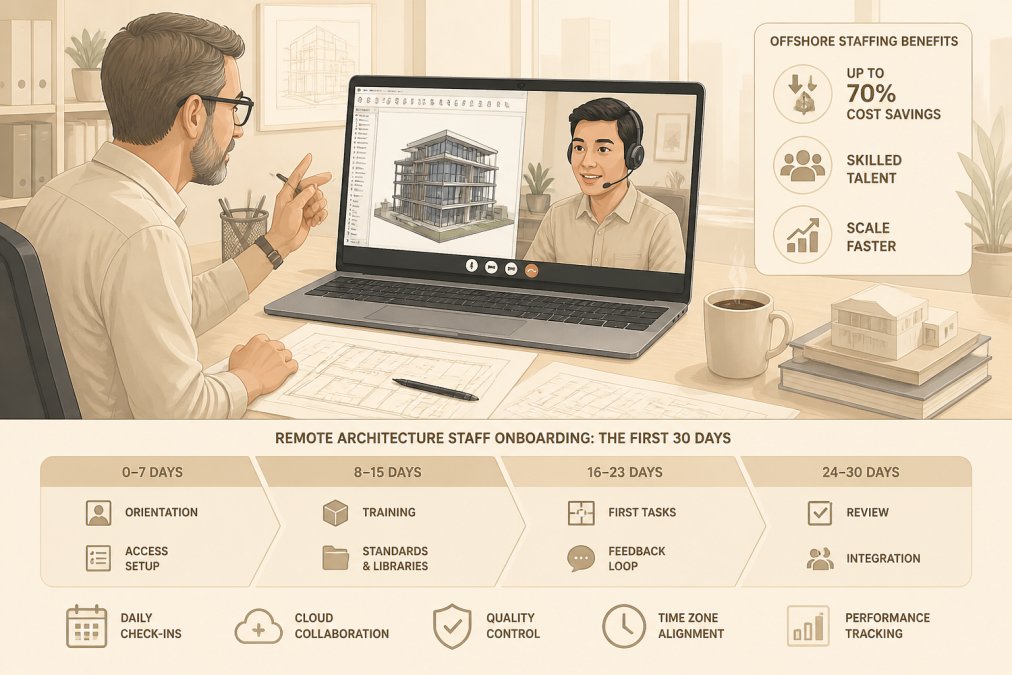
Week one should be about standards, not production. Share your template, your title blocks, your layer and family naming conventions, and a completed project they can study as a reference.
Week two introduces live work with heavy review. Assign a defined scope, review every sheet, and give specific feedback. Weeks three and four taper the review as quality holds.
A simple 30-day structure:
| Week | Focus | Your Review Level |
|---|---|---|
| 1 | Standards, template, reference project | Full review of practice work |
| 2 | First live scope, defined and small | Line-by-line review |
| 3 | Expanded scope, real deadlines | Spot-check and markup |
| 4 | Normal project load | Standard QA process |
If quality is not holding by week four, that is a signal to act, not to wait. Drafting Helpers offers $0 cost to replace a placement and has no long-term contracts.
Offshore Drafting Team Communication and Time Zone Management
Offshore drafting team communication works best when it is asynchronous by default and synchronous by exception. Expecting a drafter twelve time zones away to be on call for every question is a recipe for burnout and errors.
Set a daily overlap window of two to three hours where both sides are available for live coordination. Outside that window, rely on written handoffs: a short end-of-day note covering what was completed, what is blocked, and what needs a decision.
Practical habits that keep offshore teams aligned:
- One shared model and one source of truth for current files
- A single channel for project questions, not scattered email threads
- Written redline responses so decisions are documented
- A weekly review call that covers quality, not just status
Collaboration tools carry most of the load here. Screen recording a markup walkthrough takes three minutes and eliminates a day of back-and-forth.
Security, Compliance, and Protecting Project Files
Protecting project files starts before the first model is shared. Client confidentiality, intellectual property, and data handling need to be settled in writing, not assumed.
Ask any provider how they handle access control, device security, and confidentiality agreements. A serious offshore partner will have answers ready and will expect you to ask.
For firms working on government or institutional projects, review the applicable contract clauses before assigning any offshore resource.
Basic safeguards worth insisting on:
- Signed confidentiality and IP assignment agreements
- Role-based access to project files, revoked when a project ends
- Company-managed devices rather than personal machines
- A clear data handling policy for client information
Security is not a reason to avoid offshore staffing. It is a reason to choose a provider that takes it seriously and can document how.
Scaling Up and Down Without Long-Term Contracts
Flexible scaling is the feature that changes how firms plan capacity. Architecture workloads are cyclical, and a staffing model that locks you into fixed headcount fights against that rhythm.
With no long-term contracts, you add a drafter when a project ramps and reduce when it closes out.
If you are weighing team composition beyond drafting, it helps to see the full range of roles available on flexible terms. You can hire a remote architectural designer for SD and DD support, test fits, and visualization without adding permanent headcount.
Get Started with Vetted Offshore Revit Drafters
The firms that clear their backlogs fastest are not the ones with the biggest teams. They are the ones that stopped treating production capacity as something they had to own outright.
If you are ready to see what a vetted placement looks like, you can hire a remote drafter for your architecture firm with the specific software skills and standards your projects require.
Frequently Asked Questions
How do you hire an offshore Revit drafter?
Start by defining the scope: which project phases, drawing types, and Revit versions the drafter will handle. Then screen candidates with a portfolio review, a timed Revit drafting test, and structured interview questions about BIM workflows and construction documentation. Use a provider that vets for technical proficiency and industry experience, and confirm they handle payroll and compliance. A managed service shortens the process to days rather than months and lets you replace a poor fit at no cost.
What skills should you look for in a Revit drafter?
Look for hands-on Revit proficiency across architectural design and structural detailing, plus familiarity with BIM coordination, MEP interfaces, and construction documentation standards. Strong candidates understand project lifecycle stages, can read and produce blueprints, and follow drafting standards consistently. Check experience with 3D modeling and design software beyond Revit, and confirm they can work within your custom plugins and file setups. Communication skills matter as much as technical ones for remote work.
How do you assess an offshore Revit drafter's Revit skills?
Use a practical Revit drafting test built from a real project excerpt, not a generic exercise. Give candidates a sample model with your firm's templates, families, and view standards, then ask them to produce a specific sheet set within a set time. Score accuracy, adherence to standards, and modeling efficiency. Pair the test with portfolio review and reference checks. This shows whether they can handle your specific file setups rather than only basic drafting.
How do you onboard remote architecture staff?
Remote architecture staff onboarding should cover three areas: tools, standards, and people. In week one, set up access to your Revit environment, collaboration tools, and file structure, and walk through your drafting standards and QA process. Assign a domestic point of contact and schedule daily check-ins. In weeks two through four, move from supervised tasks to independent work with milestone reviews. Document everything in a shared onboarding checklist so replacements ramp up quickly.
How can you manage time zones and communication with offshore drafters?
Set a fixed overlap window of at least three to four hours with your firm's working day for live reviews and questions. Use asynchronous communication for everything else: written task briefs, recorded screen shares, and a shared project management board. Philippines and Latin America teams can align with US hours more easily than many other regions. Agree on response-time expectations and a single channel for urgent issues so nothing gets lost.
How do you protect project files when working with remote drafting staff?
Require signed confidentiality and intellectual property agreements before access is granted. Use role-based permissions in your file system and collaboration tools so drafters see only the projects they work on. Enable multi-factor authentication, restrict file downloads where possible, and log access to sensitive models. Choose providers that follow documented security and compliance practices. Review access rights when a project ends or a placement changes.
The challenge is straightforward: your backlog is growing, and domestic hiring cannot close the gap fast enough. Drafting Helpers provides vetted offshore Revit drafters at up to 70% less than domestic rates, with a fully managed service that covers payroll, benefits, and oversight, no long-term contracts, and $0 cost to replace a placement that does not work out. Get started with Drafting Helpers and turn your production bottleneck into predictable delivery.
